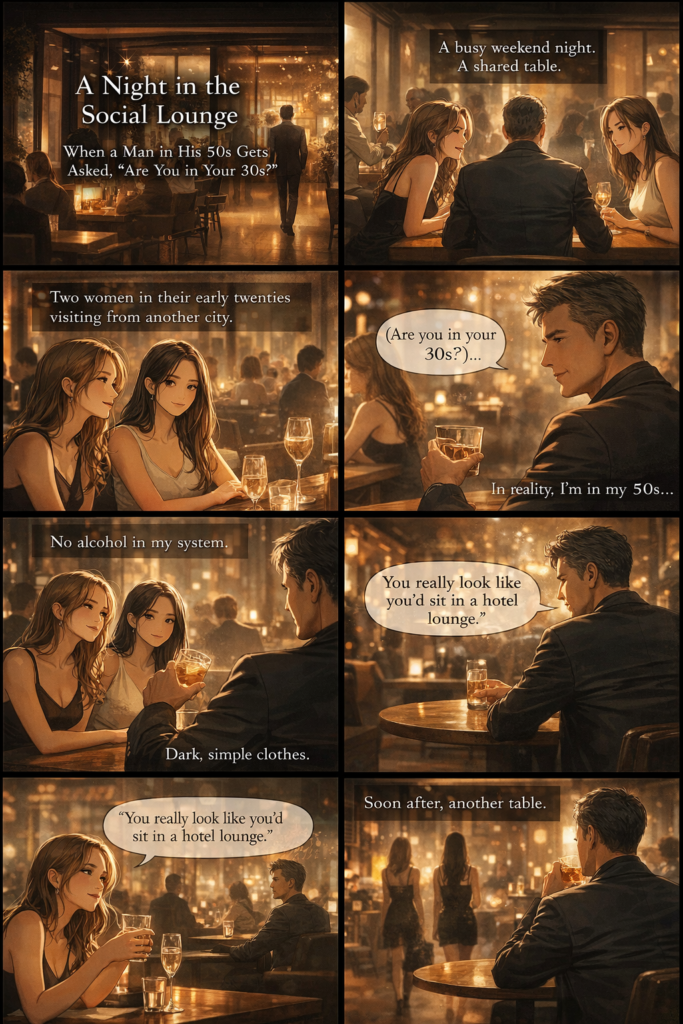
Scene Overview
- Setting: A busy weekend night in a social lounge where strangers are seated together
- My side: I walked in alone, sober as always, dressed in a simple, dark, quiet style
- Their side: Two women in their early twenties, visiting from another city on a short trip
- Extra detail: They had already missed their last train home and were planning to go back by taxi
In other words, it was a classic “one-night, all-in” situation for them:
New city, no last train, hotel or taxi back,
and a strong desire to “make the most of the night.”
That alone changes how people move, talk, and decide when to stay or move on.
Log 1: “Are you in your 30s?”
As soon as we started talking at the shared table,
one of them looked at me and asked:
“Are you in your 30s?”
In reality, I’m in my 50s.
When a woman estimates a man’s age, the pattern is often something like:
- If she’s neutral → around the real age
- If she’s being polite → a little younger
- If she says “20 years younger”, something else is at work
So being asked “Are you in your 30s?” is not just a compliment.
It’s a compact verdict on the combination of:
- face and skin
- facial line and swelling
- hairstyle, clothes, posture
- the way I sit and the way I look back at her
From my side, I know what has been stacked behind that一瞬:
- no alcohol in my system that night (and very little in general)
- long-term work on swelling and face width
- regular skin maintenance, laser care, sun protection
- EMS and attention to the jawline
- choosing dark, simple clothes that don’t shout, only整える
The point is not “I look young.”
The point is:
The investment is now visible from the outside in under three seconds.
This night simply confirmed that.
Log 2: “You really look like you’d sit in a hotel lounge. Are you a business owner?”
Later in the conversation, I mentioned very casually:
“I actually like sitting alone in a hotel lounge, just drinking quietly.”
Without missing a beat, one of them said:
“You really look like you’d do that. Are you a business owner?”
I hadn’t explained my job.
I hadn’t listed titles, achievements, company names, nothing.
Yet just from:
- the way I spoke
- how calmly I sat
- the hotel lounge remark
- the contrast between my age感 and見た目
they placed me not as “employee” but as someone on the owning side of life.
This is another type of recognition:
“You are not here to escape your everyday life.
You look like someone who already controls it.”
In a place where many people are trying to forget their routine for a few hours,
staying fully sober and calm creates a very different silhouette.
Log 3: Why the table changed (and why it wasn’t “rejection”)
Eventually, the table was changed.
Important details:
- The atmosphere was fine.
- Their expressions didn’t freeze.
- The conversation was flowing, including jokes and small personal topics.
- I didn’t see them reach out to press any “change table” button.
From the outside, it can be easy for a man to think:
“They must have asked to be moved.
I was cut. I was not chosen.”
But if you put the pieces together:
- They were on a short trip from another city
- No last train
- Taxi ride back already前提
- It was their only night there
Then their internal priority becomes:
“We paid to be here, we came all this way,
so we want to talk to as many people as possible.”
On top of that, many social lounges operate with:
- time-based rotations (“we’ll move you every X minutes”), or
- a system where staff are encouraged to keep tables moving
So the more realistic explanation is:
- This wasn’t “We don’t like him, get us out of here,”
- It was “Tonight is our one shot, let’s see different people,”
plus the venue’s own rotation logic.
In short:
It was structural movement, not personal rejection.
Log 4: How the staff saw it
There’s one more angle.
I know one of the staff members there fairly well.
After the table change, she was actually a bit annoyed on my behalf and said:
“You can press for a table change earlier from your side too, you know.”
Underneath that one line, there’s a lot:
- From the staff’s point of view, the table was not in a bad mood
- I’m seen as a guest they’d rather keep comfortable, not “someone to rotate away”
- She would have preferred I didn’t just受け身でそのまま座る,
but used my side of the system when I wanted
In other words:
From the venue’s perspective, I’m not the one being quietly rejected.
I’m one of the people they’d rather keep.
That’s an important part of the log.
Structural Summary: What This Night Really Showed
From a distance, the story could look like:
“A man sits with two women,
they talk,
then the women are moved away.”
But in terms of structure, the log reads like this:
- Young-looking verdict, externally confirmed
- A man in his 50s is immediately placed in the “30s” age bracket
- Long-term choices (no heavy drinking, skin and face care, simple style)
are now visible in under three seconds
- Positioning as “owner side,” not “employee side”
- A single remark about hotel lounges leads to
“You look like a business owner” - Calm behaviour + sober presence + language
automatically pull me into the “has his own axis” category
- The table change was about rotation, not rejection
- Two young women on a one-night trip with no last train
- Naturally high “we want to see many tables” drive
- Venue rotation logic layered on top
→ The movement was structural, not emotional
- Staff view: quietly valued guest
- A staff member being low-key upset on my side
- “You can also press to change earlier” =
“We don’t want you to be the one who just gets moved around”
Why This Log Is Free
This is not a “technique article.”
It’s not a guide on what to say in a social lounge.
It’s a raw log of how:
- sobriety
- long-term appearance maintenance
- quiet presence
- and a few simple sentences
combine into a very specific perception from strangers:
“You look younger than you are.”
“You look like a business owner.”
“You don’t seem like everyone else who comes here to escape.”
That alone is enough value for a free article.
The deeper layers—
how to turn this positioning into silent influence,
how to use it inside more private spaces,
how desire behaves around a man who doesn’t chase—
those belong in the paid, closed pages.
This page stays free on purpose:
a small, real-night snapshot for anyone who wants to see
what it actually looks like when a man in his 50s is quietly treated
as if he were in his 30s and fully in control.